Guides
Dutch children's books for adult learners: what works at A1 and A2
Most Dutch children's books are harder than they look: they are written for a Dutch child who already speaks the language. A first book written for your level works better, such as Fairy Tales at A1; next to it, a few picture books do work: nijntje (Miffy) at A1, and Kikker and Dikkie Dik around A2. Below: the readers written for your level first, then the children's books by level, what AVI on the cover means, and how to borrow them.
Start with a book written for your level
A children's book is written for a child who already knows thousands of Dutch words. A graded reader is written the other way round: for an adult who knows a few hundred, with short sentences, the hard words explained and, often, a story you already know. Ours, in level order:
Readers at A1 and A2
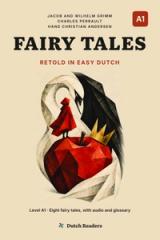
Fairy Tales is the A1 book: eight fairy tales everyone knows, from Little Red Riding Hood to The Little Mermaid, adapted into easy Dutch for learners, with a glossary and questions after each tale and audio through the QR codes in the book. It answers the children's book question for an adult: the stories of childhood, at your level.
Dutch children's books, by level
These are Dutch originals for young children, all in print. Read them for the pictures and the sound of the language, not as your main reading: they use the words of a small child (animals, toys, feelings), many diminutives (het huisje, het vogeltje) and, in the longer ones, the past tense.
| Book | Author and publisher | For an adult learner | What to expect |
|---|---|---|---|
| nijntje (Miffy) | Dick Bruna; Mercis | A1 | Square books of 28 pages: twelve pictures, and four short lines on the page next to each one, the second and fourth lines rhyming. In print: nijntje, nijntje in de dierentuin, nijntje op school, nijntje aan zee, het feest van nijntje. |
| Kleine Ezel | Rindert Kromhout and Annemarie van Haeringen; Leopold | A1 to A2 | Short stories about a small donkey, for ages 2 to 5. In print: Je allereerste verhalen van Kleine Ezel. |
| Dikkie Dik | Jet Boeke; Gottmer | A1 to A2 | A cat and his small everyday adventures; first on Dutch television in 1978, in Gottmer books since 1983. In print: Dikkie Dik gaat in bad, Dikkie Dik op de boerderij, Elke dag Dikkie Dik (365 short stories, one a day). |
| Kikker | Max Velthuijs; Leopold | A2 | Picture books of 32 pages about a frog and his friends, a few sentences a page and real subjects: love, fear, a newcomer in the wood. In print: Kikker is verliefd, Kikker en de vreemdeling, Kikker in de kou, Kikker is bang. |
Scroll sideways to see the whole table
What AVI on the cover means
Many Dutch books for children who are learning to read carry an AVI level. AVI stands for Analyse van Individualiseringsvormen. There are twelve levels: AVI Start, M3, E3, M4, E4 and so on up to E7, and AVI Plus. The letter is the middle (M, medio) or the end (E, einde) of the school year, and the number is the school group: groep 3 is the year Dutch children learn to read, at about six. Cito, which makes the test, sets the level of a book.
The AVI test measures how fast and how well a child reads a text aloud. It does not measure the words a child already knows from speaking. So a book at AVI Start or M3 is easy to read aloud, usually with short words and short sentences, which helps you, but it still assumes the spoken vocabulary of a Dutch child. Picture books for reading aloud, such as nijntje and Kikker, usually carry an age, not an AVI level.
Borrow them from a Dutch library
- Visiting a public library is free; borrowing needs a membership. Up to 18 it is always free. For adults the fee differs per library, because each town or region has its own.
- Picture books (prentenboeken) are in the children's section. In the OBA in Amsterdam, for example, the catalog gives picture books an age, and first readers carry an E and their AVI level on the spine.
- Many libraries have a Taalhuis: free help with learning Dutch, and you do not need to be a member.
For later: Jip en Janneke
Jip en Janneke by Annie M.G. Schmidt, with drawings by Fiep Westendorp, first appeared in the newspaper Het Parool in 1952 and is still in print. Its sentences are famously short, about six words on average, and "Jip-en-Janneketaal" is what Dutch people call plain language. The words are another matter: the everyday talk of a Dutch family in the 1950s, its games, its jokes and its expressions. For an adult learner we put it at B1, as on Dutch books for beginners. Keep it for later, and enjoy it then.
See it in a text
A1 reading, written for adults, sounds like this. From De deur, A1:
- Luca kijkt om. De deur is dicht. Zijn sleutels liggen binnen. Luca looks around. The door is closed. His keys are inside.
And from Melk op zondag, A1:
- Het is zondag, negen uur. Om tien uur komt de buurvrouw op de koffie. Pedro pakt de melk. De fles is leeg. It’s Sunday, nine o’clock. At ten o’clock, the neighbor is coming over for coffee. Pedro gets the milk. The bottle is empty.
Short sentences in the present tense, the words of an adult day: keys, a neighbor coming for coffee. That is what a children's book cannot give you.
Read next
All the free A1 texts, each with audio and a glossary, are on Dutch texts at A1. For the whole range of books at A1 and A2, course books included, see Dutch books for beginners. And for a whole book at A1, Fairy Tales.
Are children's books good for learning Dutch?
Some are, at A1: nijntje has four short lines a page and pictures that explain the words. Most are harder than they look, because they are written for a child who already speaks Dutch. Use them next to texts written for your level, not instead of them.
What level is nijntje?
A1. Each page has four short lines, the second and fourth rhyming, and a picture beside them. It is the one Dutch children's series that a real beginner can read alone.
What does AVI mean on a Dutch children's book?
It is the reading level for Dutch children learning to read, from AVI Start to AVI Plus: M3 means the middle of groep 3, the first reading year at school. It is about how fast and how well a child reads aloud, not how many words a child knows.
Can adults borrow children's books from a Dutch library?
Yes, with a library membership, which is free up to 18 and has a fee for adults that differs per library. Visiting and reading in the library are free.