Guides
Dutch graded readers by level: A1, A2 and B1
A graded reader is a book written inside a level, so you can read it from the first page to the last without a dictionary. Here are the Dutch Readers books by level: famous stories retold in easy Dutch, each with a glossary, questions and audio, and the free texts on this site to start with.
The books, side by side
| Book | Level | Length | Audio | Price | Free to try |
|---|---|---|---|---|---|
| Fairy Tales | A1 | Eight fairy tales, about 3,500 words, 83 pages | Every tale, through a QR code in the book | Paperback 10.99 euro | The first tale, Roodkapje |
| Dracula | A2 | Eight short chapters, about 7,000 words, 87 pages | Every chapter, through a QR code in the book | Paperback 10.99 euro, Kindle 4.99 euro | Chapter 1 |
| Alice in Wonderland | A2 | Seven short chapters, about 6,000 words, 80 pages | Every chapter, through a QR code in the book | Paperback 10.99 euro, Kindle 4.99 euro | Chapter 1 |
| Saïdjah and Adinda | A2 | Eight short chapters, about 6,800 words, 89 pages | Every chapter, through a QR code in the book | Paperback 10.99 euro, Kindle 4.99 euro | Chapter 1, Saïdjah en de buffel |
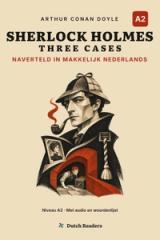
| Sherlock Holmes: Three Cases | A2 | Eight short chapters, about 7,500 words, 97 pages | Every chapter, through a QR code in the book | Paperback 10.99 euro | Chapter 1 |
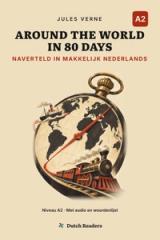
| Around the World in 80 Days | A2 | Eight short chapters, about 7,500 words, 95 pages | Every chapter, through a QR code in the book | Paperback 10.99 euro | Chapter 1 |
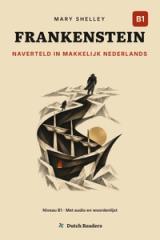
| Frankenstein | B1 | Six chapters, about 9,000 words, 91 pages | Every chapter, through a QR code in the book | Paperback 10.99 euro | Chapter 1 |
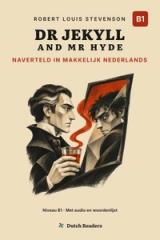
| Dr Jekyll and Mr Hyde | B1 | Five chapters, about 8,000 words, 87 pages | Every chapter, through a QR code in the book | Paperback 10.99 euro | Chapter 1 |
| The free texts on this site | A1 to B1 | Short texts of about 300 to 750 words, ten minutes each | On nearly every text | Free | Every text |
Scroll sideways to see the whole table
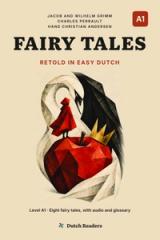
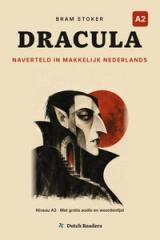
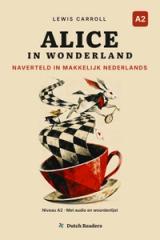
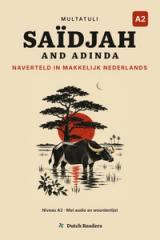
Every book has the same parts: who's who before you start, a glossary in Dutch and English and five questions after every chapter, the answers and the complete word list at the back. Every book is written with the most common Dutch words for its level, and the harder words are in the glossary.
What makes a reader a graded reader
Three things, and a book needs all three. The vocabulary is controlled: the writer works from a list of the words a learner at that level knows, and anything outside the list is explained. The sentences are short and the grammar stays inside the level, so the simple past comes in at A2 and a B1 book has at most a short sub-clause inside another. And the hard words are glossed where you meet them, in the margin or after the chapter, so you never leave the story to find a dictionary.
A children's book has none of these: it is written for a native five-year-old with five thousand words. A bilingual book (Dutch on the left, English on the right) has only the gloss, and most learners read the English. A graded reader is the only kind of book you can finish at A2, and finishing a book is what turns a learner into a reader.
Each book, honestly
Fairy Tales (A1)
Eight tales from Grimm, Perrault and Andersen, from Little Red Riding Hood to The Little Mermaid, each told whole in A1 Dutch, in the present tense. It suits a beginner in the first months, because you already know every story and can follow it with few words. What is hard: the words of a fairy tale (a wolf, a mirror, a ball) are not the words of the bakery, so the glossary works harder here than in the other books. There is no Kindle edition yet.
Dracula (A2)
Bram Stoker's novel in eight short chapters: Jonathan Harker's journey to the castle in Transylvania, then London, where Lucy grows paler every day. It suits the learner who wants a story that pulls them to the next chapter. What is hard: the past tense from the first page, and a lot of people and places, which the list at the start of the book helps you keep apart.
Alice in Wonderland (A2)
Lewis Carroll's story in seven short chapters: the White Rabbit, the Cheshire Cat, the tea party and the Queen of Hearts. It is the shortest of the A2 books, so it is the gentlest whole book at A2. What is hard: Wonderland makes no sense on purpose, so the story cannot always help you guess a word the way Dracula's can.
Saïdjah and Adinda (A2)
The love story from Multatuli's Max Havelaar (1860), a classic of Dutch literature, set in a village on Java under Dutch rule. It suits a learner who wants a Dutch classic, or a story from the Canon van Nederland for the inburgering. What is hard: the names and places of Java, which the book explains before you start, Saïdjah's song, and the end, which is sad.
Sherlock Holmes: Three Cases (A2)
Three of Arthur Conan Doyle's cases in eight short chapters, told by Doctor Watson: a king who wants a photograph back, a pawnbroker with red hair who was paid to copy an encyclopedia, and a woman who wants to know what killed her sister in a locked room. It suits a learner who likes a puzzle; each case is a whole story in two or three chapters. What is hard: it is the longest of the A2 books, each case brings new people and places, and each turns on one small detail, so the word you skip may be the clue. There is no Kindle edition yet.
Around the World in 80 Days (A2)
Jules Verne's race against the clock in eight short chapters: Phileas Fogg, a London gentleman who does everything to the minute, bets 20,000 pounds that he can go round the world in 80 days and leaves that same night with his new servant, Passepartout. Behind them comes Fix, a detective who is sure that Fogg robbed the Bank of England. It suits a learner who wants an adventure that moves fast, on a journey you can follow on a map. What is hard: the story goes from London to India, China, Japan and America by train, ship and even elephant, so the places change all the time, and it counts days, hours and pounds all the way, so you read a lot of numbers and clock times. There is no Kindle edition yet.
Frankenstein (B1)
Mary Shelley's novel in six chapters: Victor Frankenstein makes a being, runs from it, and the creature, alone, learns to speak and read in secret. It suits a learner at B1 who wants a real novel; it is quieter, stranger and sadder than the films. What is hard: the chapters are longer than in the A2 books, and three people tell the story in turn. There is no Kindle edition yet.
Dr Jekyll and Mr Hyde (B1)
Robert Louis Stevenson's London mystery in five chapters: a small man who tramples a child in the street at night, a door with no bell, and the will of the respected Dr Jekyll, which leaves everything to that man, Edward Hyde. The lawyer Utterson wants to know why a good doctor protects him. It suits a learner at B1 who wants a short, dark story whose title everyone knows, with no love story in it. What is hard: the chapters are as long as Frankenstein's, the words of a lawyer's world (a will, a safe, a cheque) come in the first chapter, and the story keeps its answer for the end, so you read on with questions. There is no Kindle edition yet.
The free texts on this site
Our texts are checked word by word against the most common Dutch words at A1, A2 and B1, with audio, a glossary you tap, questions with answers and a word list on every page. They are free, and they are the best way to find your level before you buy a book: if a text at a level reads easily, a book at that level will too.
Which one for you
- A1: Fairy Tales. Read Roodkapje, the first tale, for free; if it reads well, the book is the next step.
- A2, a story you cannot put down: Dracula, with chapter 1 free.
- A2, something funny and short: Alice in Wonderland, with chapter 1 free.
- A2, a Dutch story: Saïdjah and Adinda, with the first chapter, Saïdjah en de buffel, free.
- A2, a detective story: Sherlock Holmes: Three Cases, with chapter 1 free.
- A2, an adventure against the clock: Around the World in 80 Days, with chapter 1 free.
- B1, a real novel: Frankenstein, with chapter 1 free.
- B1, a dark mystery: Dr Jekyll and Mr Hyde, with chapter 1 free. Read a few B1 texts first; if they go well, the B1 books will too.
- Not sure of your level: the free level test takes about ten minutes, and the free texts are sorted by level.
What is the best graded reader for learning Dutch?
The one at your level that you want to finish. On this site that is Fairy Tales at A1; Dracula, Alice in Wonderland, Saïdjah and Adinda, Sherlock Holmes: Three Cases or Around the World in 80 Days at A2; and Frankenstein or Dr Jekyll and Mr Hyde at B1. Read a free first chapter at your level first: if you can follow the story with the glossary, you can read a whole book at that level.
Are there free Dutch graded readers?
On this site every reading text is free, from A1 to B1, with audio, a glossary and questions, and the first chapter or tale of every book is free too. Printed graded readers are not free, but public libraries lend books in easy Dutch.
Are Dutch graded readers available with audio?
The Dutch Readers books are: every chapter has audio, through a QR code in the book, and nearly every reading text on this site has audio too. Listen to a chapter first, then read along, or read first and listen after.
At what level can I read a graded reader?
From the end of A1 with the glossary and the audio, and comfortably at A2. If the first page has more than ten words you do not know, go one level down or read the free texts first. The free level test on this site takes about ten minutes.
Keep reading
Best books to learn Dutch in 2026, by level (A1 to B2)
Dutch books for beginners (A1 and A2): what you can actually read
B1
Dutch books for intermediate learners (B1 and B2): from readers to real novels
Classic stories adapted into easy Dutch, from A1 to B1
Graded readers in Dutch: what they are and how to use them